The Craft
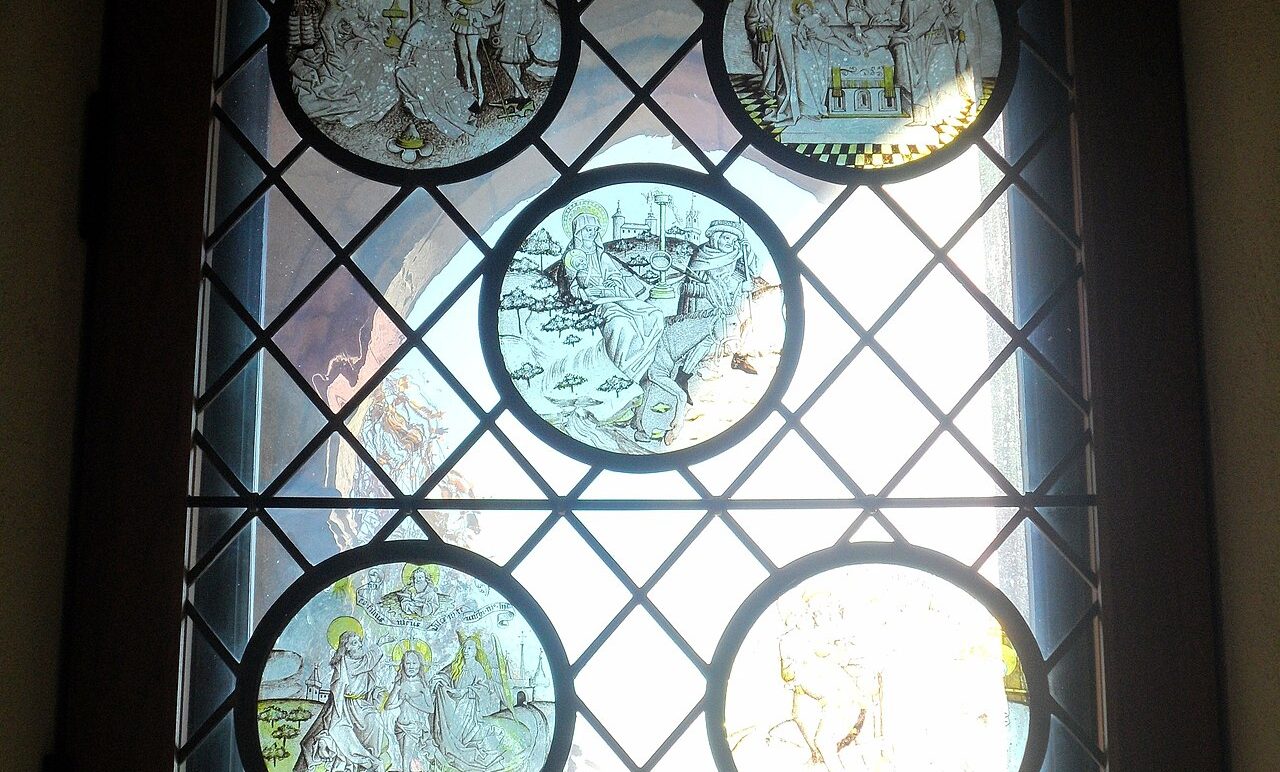
Every window we make begins as a full-size drawing on brown paper. The cartoon carries the lead line, the cut line and the paint, and every piece of glass in the finished window is cut against it in turn. Nothing about that sequence has changed since the thirteenth century.
Cutting
Mouth-blown antique glass varies across its own sheet — in thickness, in colour density, in the direction of its striations. Selecting where in a sheet a piece comes from is a design decision, not a material one, and it is why we buy roughly a third more glass than any window needs.
Painting
Vitreous paint is ground glass, iron oxide and gum arabic. It goes on wet with a badger, is stippled and stippled back, and is then fired at around 640°C until it fuses into the surface. It cannot be undone. A badly judged trace line means cutting the piece again and starting it over.
Leading
Came is stretched to take the spring out of it, cut with a lead knife, and shaped around each quarry in turn from a fixed corner outwards. Every joint is soldered on both faces. A panel is glazed flat and it must come off the bench flat.
Cementing
Whiting, plaster, linseed oil, turpentine and lamp black, brushed under the leaves of the came from both sides, then dusted with whiting and brushed off. Two filthy days. A panel that has not been cemented properly is not weatherproof, and will rattle.
Fixing
Stainless saddle bars, copper ties, and lime mortar. We do not use cement mortar against historic stone, and we do not fix a panel we have not personally surveyed in its opening.