Ardross Cathedral, west front · Ardross
The Ninefold Rose
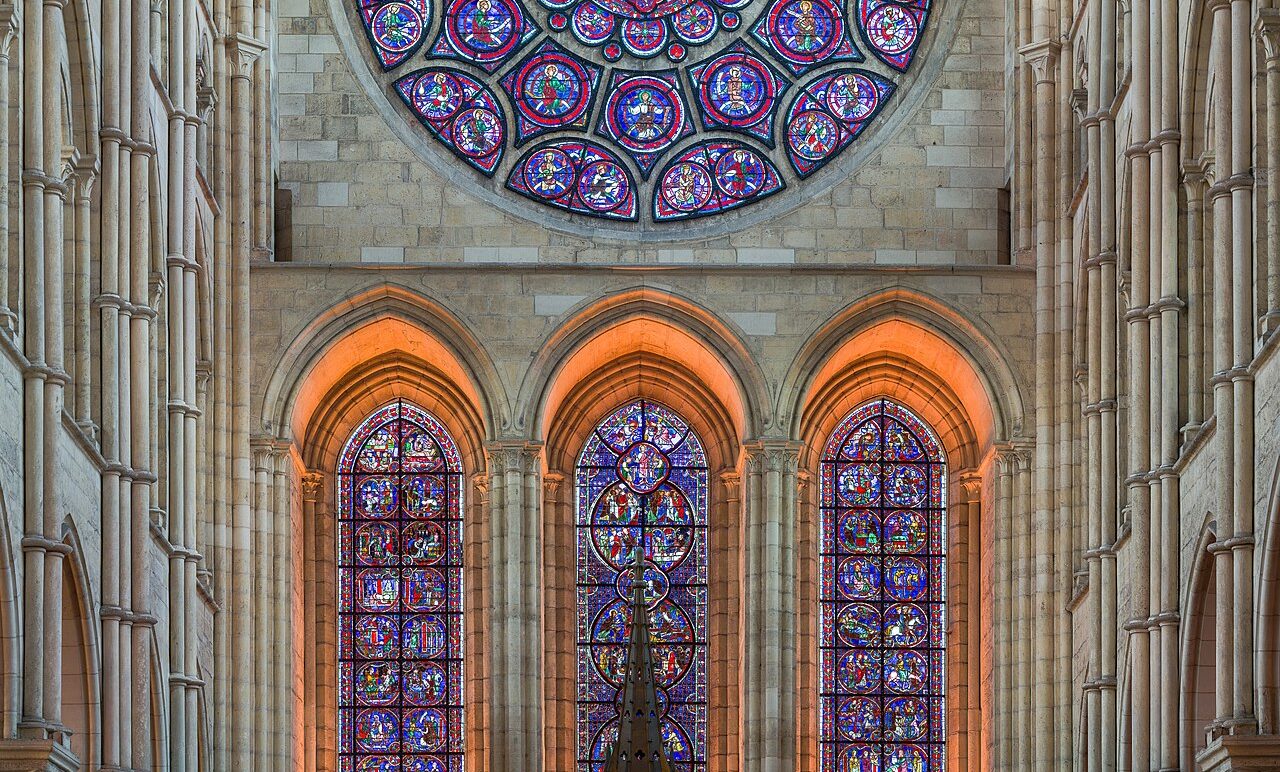
The west rose had been leaking since the war. We took it down over two summers, releaded all nine lights and put back the four quarries a Victorian repair had got wrong.
Completed2021
Lights9 lights + tracery
Panels46 panels
Glazed area31.4 m²
GlassOriginal 1290s glass, losses in Lamberts antique
Came9.5 mm and 13 mm restoration lead
Firings61
JobConservation
The window
The rose had been on the fabric committee’s list since 1946, which is a long time for anyone to live with a window that lets the weather in. When we finally got the scaffold up in the spring of 2019 the problem was not the glass at all. It was the ferramenta. The original iron had been packed into the stone with lead and had been rusting outward ever since, and rust occupies more room than iron does. Every one of the nine lights was under compression from its own frame.
That changes the job. You are no longer conserving glass, you are conserving glass while dismantling the thing that is breaking it, and the two have to happen in an order that never leaves a panel unsupported. We worked from the outside lights inward, two per season, and each panel came down under a rubbing taken the day before so we would know exactly where it had been.
What we found in panel 22
Panel 22 had no medieval glass in it whatsoever. Someone in the 1870s had replaced the whole panel in a passable imitation and then, to be fair to them, recorded that they had done so — on a lead flag soldered inside the border, which is more honesty than most of that century managed. We have left their flag in and added our own beside it.
The replacement glass we cut for the losses is deliberately a shade brighter than what surrounds it. That is a conservation decision, not an aesthetic one. A repair that matches perfectly on the day it goes in becomes a lie within twenty years, when it has weathered differently from the glass around it and nobody can tell any more which is which.
The four quarries
In four places the Victorian restorer had reassembled fragments in the wrong order. We know because the paint runs off the edge of one piece and continues on a piece two quarries away. Correcting it took a fortnight of laying fragments out on the bench under raking light and photographing every arrangement before moving anything. The cathedral archive now holds the whole sequence.
Panel by panel
Panel 3
The 1878 repair had inserted a modern ruby quarry upside down. Photographed, recorded, and turned.
Panel 11
Two-thirds original. Edge-bonded with silicone rather than releaded — the paint was too fragile to handle twice.
Panel 22
Complete loss. Made new, in glass matched by eye against panel 21 on the bench, not against a swatch.
Tracery
All eight tracery lights taken out, cleaned, and put back with new saddle bars in stainless rather than the original iron.
Elsewhere